TL;DR
If you're dealing with official documents in Brazil, only sworn translations (tradução juramentada) are legally accepted. Certified translations commonly used in the UK or US do not meet Brazilian legal requirements.
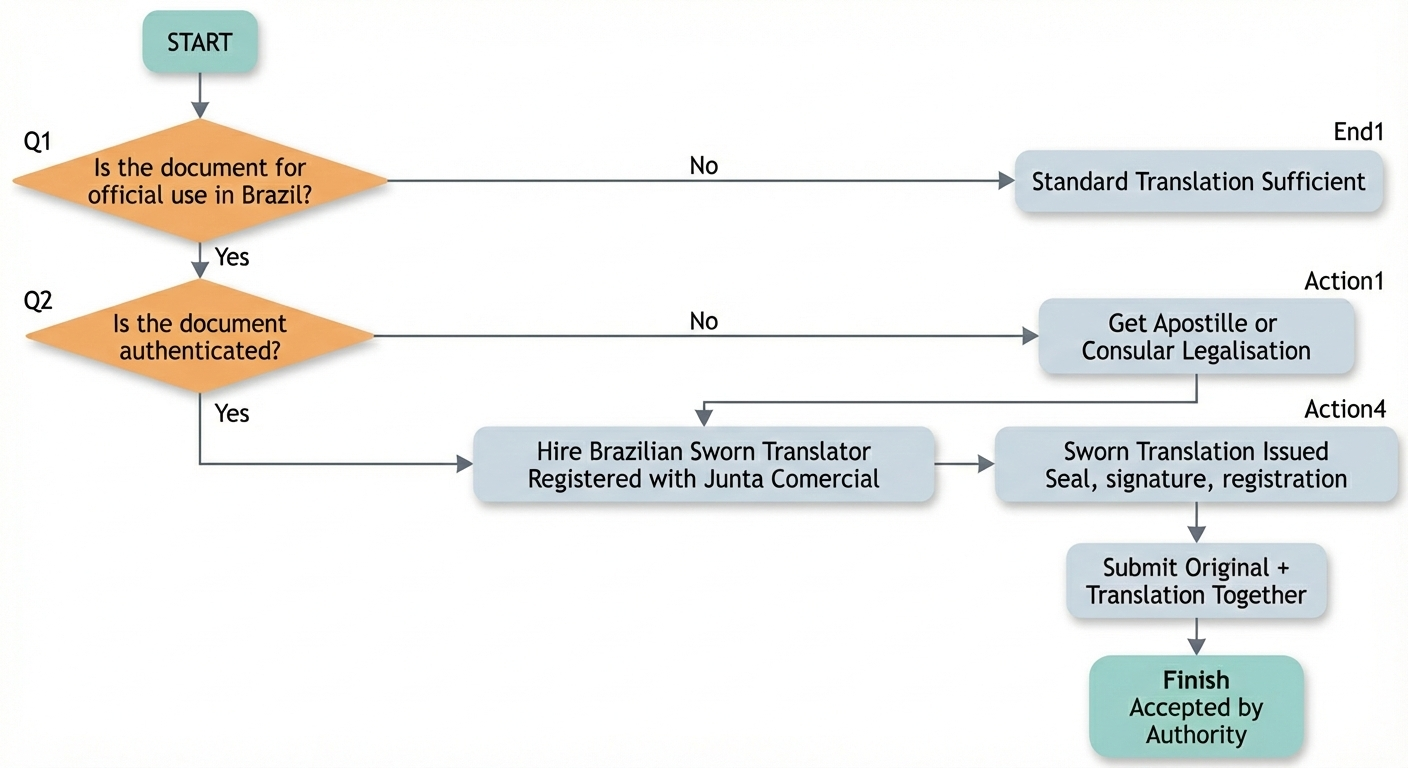
In most cases, your document must be apostilled first, then translated by a Brazilian sworn translator registered with a state Board of Trade. Understanding this process upfront can save time, cost, and frustration.
Sworn Translation vs Certified Translation
Although the terms are often used interchangeably abroad, they mean very different things in Brazil.
A sworn translation (tradução juramentada) is a legally mandated document. It is the only form of translation accepted by Brazilian courts, public authorities, notaries, banks, and government agencies.
A certified translation, as commonly understood in the UK or US, confirms linguistic accuracy and professional competence. However, it has no legal standing in Brazil and is generally rejected for official use.
- Sworn translation is a legal requirement in Brazil
- Certified translation ≠ sworn translation
- Only sworn translations have nationwide legal validity
When Is a Sworn Translation Required?
As a general rule, any foreign-language document submitted to Brazilian authorities must be sworn-translated.
Common scenarios include:
- Immigration and residency applications
- Court proceedings and legal filings
- Birth, marriage, divorce, and death certificates
- Academic validation and university enrolment
- Employment and professional documentation
- Commercial, corporate, and financial transactions
- Real estate purchases or rentals
Submitting a foreign document without a sworn translation usually results in automatic rejection.
- Official use = sworn translation required
- This applies across legal, academic, commercial, and immigration contexts
Are There Any Exceptions?
Yes – but they are limited and situation-specific.
Sworn translation may not be required when:
- The document is for personal or informational use only
- The document is being reviewed privately and not submitted to authorities
- Certain visa applications are completed outside Brazil via a consulate
- Proof of address documents are submitted
- Passports or visa stamps are accepted without translation (unless specifically requested)
If the same process is handled inside Brazil, sworn translation is usually mandatory.
- Exceptions exist, but they are narrow
- Requirements may change depending on the authority involved
- When in doubt, assume sworn translation is required
Apostille: The Essential First Step
Before any sworn translation can take place, the original document must be authenticated.
If the issuing country is part of the Hague Convention, this is done via an Apostille. If not, consular legalisation applies.
Crucially, the apostille must come before the translation. Apostilling a translated document is not valid and will lead to rejection.
- Apostille first, translation second
- Skipping this step invalidates the entire process
- Translation quality cannot compensate for missing authentication
Who Can Perform a Sworn Translation?
Only a Public Translator and Commercial Interpreter may issue sworn translations in Brazil.
To qualify, the translator must:
- Pass a public examination
- Be officially appointed
- Be registered with a Brazilian state Board of Trade
- Be based in Brazil
Translations produced abroad or by non-registered professionals – even if certified – have no legal value in Brazil.
- The translator's registration matters as much as the translation itself
- Location and official status are mandatory
How to Find a Sworn Translator
There are two common routes:
1. State Boards of Trade (Juntas Comerciais)
Each Brazilian state maintains a public registry of sworn translators, searchable by language pair.
2. Translation Companies
Some agencies act as intermediaries and work directly with sworn translators. It's essential to confirm:
- The translator is officially registered
- The deliverable is a sworn translation (tradução juramentada)
If a language pair is unavailable, authorities may allow:
- An ad hoc appointment
- A triangulated translation via an intermediary language
Format, Submission & Validity Rules
A sworn translation does not replace the original document – it enables its legal use.
Key requirements include:
- Original document and translation submitted together
- Replication of structure, stamps, seals, and markings
- Formal, faithful, non-interpretive style
- Official seal, signature, and registration details
Some institutions require printed originals, and certain documents may need additional registration after translation.
- Sworn translations follow strict formal standards
- Acceptance may vary slightly by institution
Costs and Pricing Structure
Sworn translation fees are regulated by each state and charged per lauda (typically 1,000 characters without spaces).
Costs vary depending on:
- State of registration
- Document type
- Language pair
- Urgency
Legal and judicial documents typically cost more, and urgent delivery may incur additional fees.
Final Thoughts
For a foreign document to function legally in Brazil, two things must happen:
- Apostille confirms international authenticity
- Sworn translation enables legal use within Brazil
Understanding this distinction early helps avoid delays, rework, and unnecessary expense – especially for time-sensitive legal, immigration, or commercial matters.
If you'd like, I can help you navigate this process – just get in touch!